2026/06/02
【2026 Latest Regulations】Cosmetics PIF may face fines of millions if not approved? A must-see list of regulatory pitfalls and time-saving tips for brands before going public.
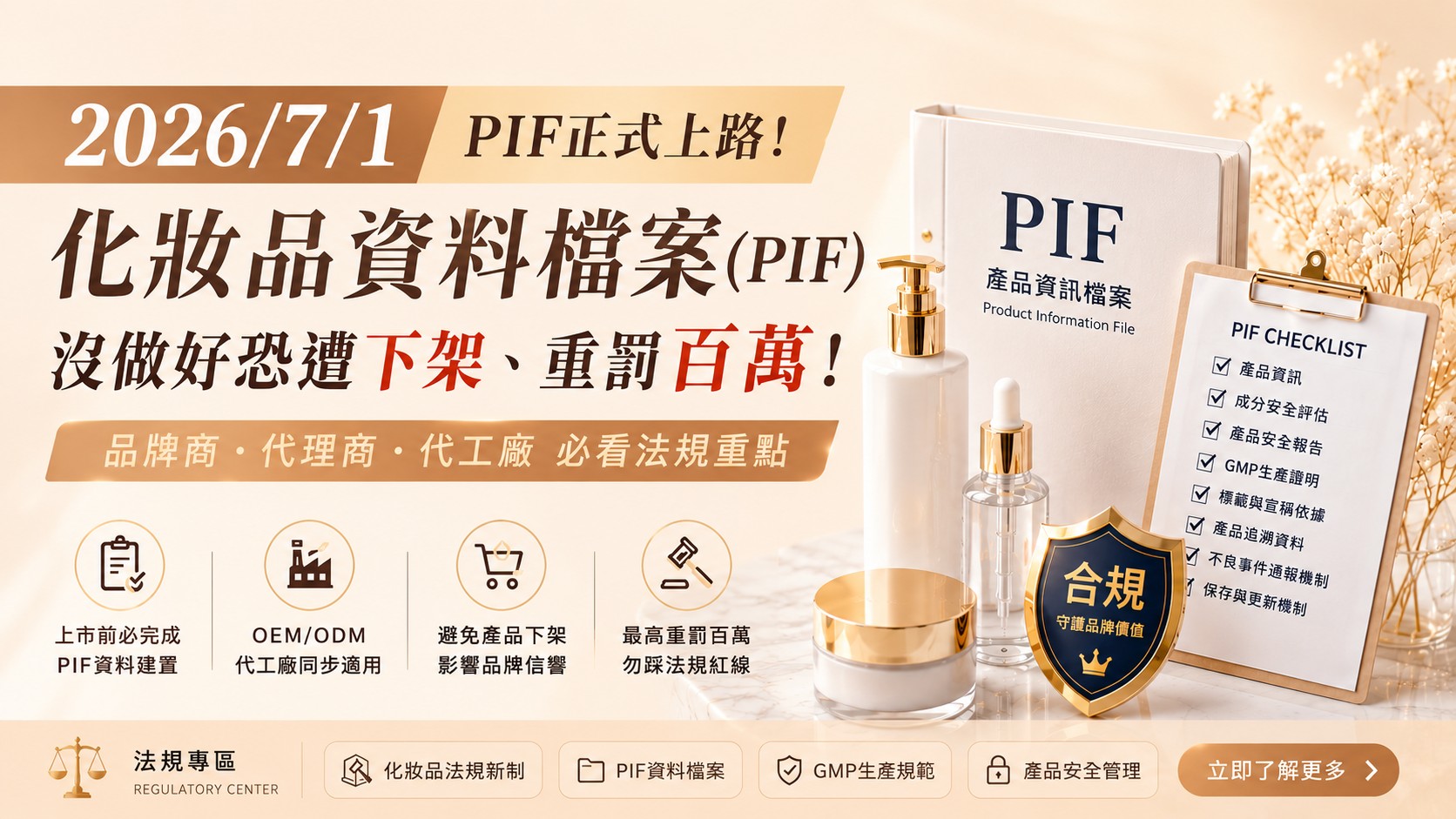
Taiwan's PIF (Product Information File) regulations have fully entered the final mandatory implementation phase.According to the Ministry of Health and Welfare's 'Cosmetic Hygiene and Safety Management Act',
all cosmetics circulating in the market (including gifts, samples, and imports) must have a PIF prepared before being marketed, or they will face fines of up to 1 million NT dollars and mandatory removal from shelves.
- July 1, 2024 (Phase 1 has been implemented): Specific purpose cosmetics (such as sunscreen, hair dyeing, antiperspirants, etc.) must establish a PIF.
- July 1, 2025 (Phase 2 has been implemented): General cosmetics for infants, lips, eyes, and non-steroidal acne treatments for specific areas or functions.
- July 1, 2026 (Final phase fully implemented):All general cosmetics are fully applicable.This includes facial cleansers, toners, body lotions, perfumes, etc., without exception.
Who is responsible for : How long does PIF need to be kept? The legal responsibilities that brand owners cannot ignore.
One of the most common questions from many bosses is: 'The products are made by the factory; shouldn't the factory be responsible for the regulatory documents?' But this is actually the biggest misconception.In the eyes of the law, whoever's name appears on the packaging is the primary responsible person for the PIF.Although brand owners can delegate the organization of documents to contract manufacturers or professional consultants, this legal obligation cannot be transferred.
If we compare the PIF to a health insurance card for products, the contract manufacturer is like a doctor responsible for providing examination data, but this card must ultimately be properly kept by the brand owner (the cardholder). In case of an inspection by the authorities, the brand owner must be able to present the files immediately. In practice, we assist brand owners in preparing most of the technical reports and data, butwhether the files are complete, stored in the company, or expired, these legal responsibilities will ultimately return to the brand side.
| Category | Responsible Party | Description |
| Domestic Cosmetics | Manufacturer (Contract Manufacturing) | If it is OEM/ODMContract Manufacturing, the responsibility still lies with the brand owner. The contract manufacturer can usually assist in establishing the PIF. |
| Manufacturer (Self-produced and Operated) | The manufacturer is responsible for establishing the PIF. | |
| Imported Cosmetics | Importer (Agent/Importer) | The party responsible for importing and selling is responsible for establishing the PIF. |
▲Table created by: Ministry of Health and Welfare Product Information File PIF Responsible Party Comparison Table
化妝品 PIF Essential Checklist, a time-saving reference for brand owners.
Many people hesitate when they hear they need to prepare 16 documents, but as long as they clarify 'who has the information', the task becomes half as simple. We have organized this comparison table for everyone, and we suggest brand owners can take this table to consult with the contract manufacturer to confirm which parts the factory will help you with.
| Item Classification | 16 Core Document List | Where does the data come from? (Suggested Sources) |
| Product Description | 01.Basic Product Information 02.Proof of completion of product registration 03.Full ingredient names and their respective contents 04.Product labels, inserts, outer packaging, or containers 05.Proof or declaration that the manufacturing site complies with good manufacturing practices for cosmetics 06.Manufacturing methods and processes 07.Usage methods, areas, dosage, frequency, and target groups 08.Data on adverse reactions to product use | Brand owners and contract manufacturers (Mostly basic documents during product development) |
| Quality Data | 09.Physical and chemical properties of the product and individual ingredients 10.Toxicological data of ingredients 11.Product stability test reports 12.Microbial testing reports 13.Preservative efficacy test reports | Contract manufacturers and raw material suppliers (Requires laboratory data support) |
| Function and Packaging Materials | 14.Supporting data for functional evaluation 15.Data on packaging materials that come into contact with the product | Testing units and packaging material suppliers |
| Safety Assessment | 16.Product safety data | Professional safety data signatory (SA) |
▲ Table created by: Ministry of Health and Welfare Product Information File PIF 16 Document Source Comparison Table
如何高效準備化妝品產品資訊檔案 PIF?
According to the Ministry of Health and Welfare's'Guidelines for the Preparation of Cosmetic Product Information Files', the PIF does not have a standard format; it is more like aevidence checklist.The key is not how thick the document is prepared, but whether this file can achieve 'traceability and verifiability' when faced with an audit.
Tips for Efficiently Preparing PIF
Brand owners do not need to become regulatory experts themselves. Besides the specifications (COA) provided by raw material suppliers and safety studies from academic literature, the most critical partner is your contract manufacturer. A professional contract partner should help you prepare the manufacturing process, microbiological testing, and stability reports during production and development.
The 16 Core Contents of Cosmetic PIF: Breakdown of Four Major Modules
To give everyone a clearer idea, Chuangchi Biotech has summarized these 16 documents into four practical modules, allowing you to understand the preparation direction at a glance:
- Category One: Product Background Investigation (Items 01 - 08)
This part is the most basic, mainly proving 'who this product is, where it is made, how it is made, and how to use it.'It includes a full ingredient list (INCI Name), manufacturing process, usage instructions, photos of the packaging box, andGMP/ISO 22716related certification documents. The packaging label must be completely consistent with theCosmetic Registration Systemwhich is often overlooked.
- Category Two: Quality and Experimental Data (Items 09 - 13)
This part is the 'health check report' of the product, proving that the product is stable on the shelf.It includes the physicochemical properties/toxicological data of the product and ingredients, stability tests (shelf life), microbiological tests (total viable count, Staphylococcus aureus, Pseudomonas aeruginosa, Escherichia coli, Candida albicans), and preservative efficacy.
- Category Three: Confidence in Appearance and Claims (Items 14 - 15)
This part proves 'the functions you claim are real' and 'the container does not release toxins.'It includes functional evidence (such as sunscreen, antibacterial, whitening, etc.) and packaging material reports (to ensure that plasticizers or heavy metals do not leach out).
- Category Four: The Ultimate Gatekeeper (Item 16)
This is the soul of the PIF and the most challenging part.This item must be personally signed by an SA with specific educational qualifications and training certifications. The SA will conclude based on the previous 15 items of information: this product is safe under normal use. Without this signature, the entire PIF is invalid.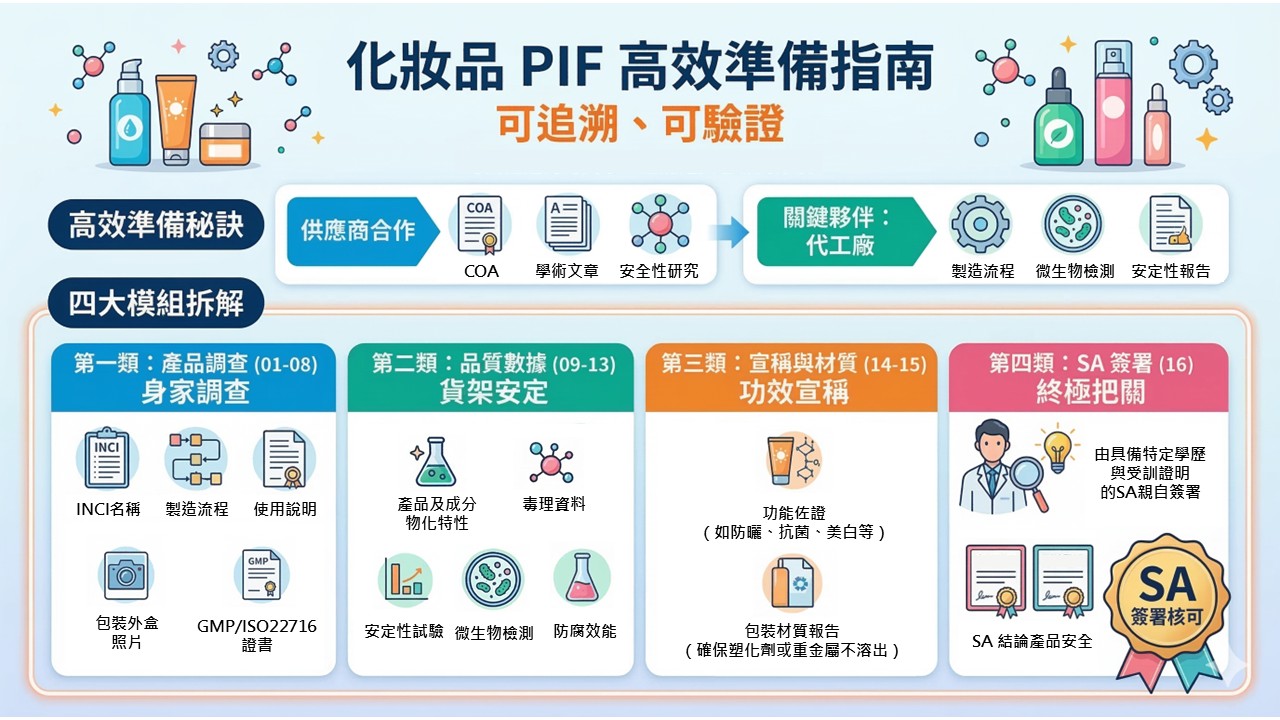
最高罰百萬!PIF 沒過關後果這麼嚴重?
Why is the Ministry of Health and Welfare so strict? It is actually for the sake of 'safety.' Many brand owners think that PIF is just a formality, and a report can be submitted casually. But if something goes wrong, this document is the key evidence to prove that the brand has fulfilled its safety responsibilities. If you cannot produce the PIF or the information is incomplete, in the eyes of the regulatory authority, this is equivalent to a 'product of unknown origin and risk.'As long as any of the following three situations are audited, you will directly cross the legal red line:
- Completely unprepared:If the product has not yet been launched, given away, or provided for testing, the documents must be prepared in advance. Not doing so is a violation.
- Randomly filled data:Falsifying data or ingredient information to rush to market is more serious than not doing it at all.
- Deadline not met:If requested to supplement or correct after an inspection, but not handled within the deadline.
List of PIF Penalties and Legal Consequences from the Ministry of Health and Welfare
This table is not meant to scare everyone, but to remind you that the cost of violations is much higher than hiring a professional team to do the PIF.It is recommended that brand owners incorporate PIF planning during the development stage, so that the products painstakingly established do not get ruined by regulatory risks.Risk Categories
| Specific Costs and Legal Restrictions | Monetary Fines | |
| Fines | Fines ranging from NT$10,000 to NT$1,000,000. | Per Incident Penalty |
| If the violation is not corrected, penalties will continue until compliance is achieved. | Market Ban | |
| Prohibition of Circulation | Violating products cannot be sold, given away, or even tested. | Recall/Destruction |
| Regulatory authorities will require businesses to recall within a specified period; non-compliance will result in confiscation and destruction. | Revocation of Qualification | |
| For serious violations, revocation or annulment of cosmetic product registration. | Business Crisis | |
| (For serious violations) Order to Suspend Business | Suspension of business for 1 month to 1 year, which is a fatal blow to any company. | Company Deregistration |
| The most severe consequence could be the annulment of the company's or factory's registration, equivalent to the brand's declaration of termination. | Prohibition Clause | |
| After registration is annulled, the product is banned for one year, and star products will completely disappear for a year. | ▲ Table created by: Ministry of Health and Welfare Product Information File PIF Penalties and Legal Consequences List | |
常見問答(FAQ)
QA
AQ PIF A
AA
AA PIFPIF
AAPIF If the product's formula, use, and labeling content are completely consistent, and only the packaging capacity is different, multiple capacities and packaging styles can be noted in one PIF, without needing to create separate files. However, each version's information must be clearly listed for inspection.
QGuide to New Cosmetic Brands, Summary of Market Launch Inspection Processes and Regulatory Classification Key Points!
A