2026/06/17
Microneedling treatments are trending, and beauty professionals must pay attention to regulatory boundaries before operating!
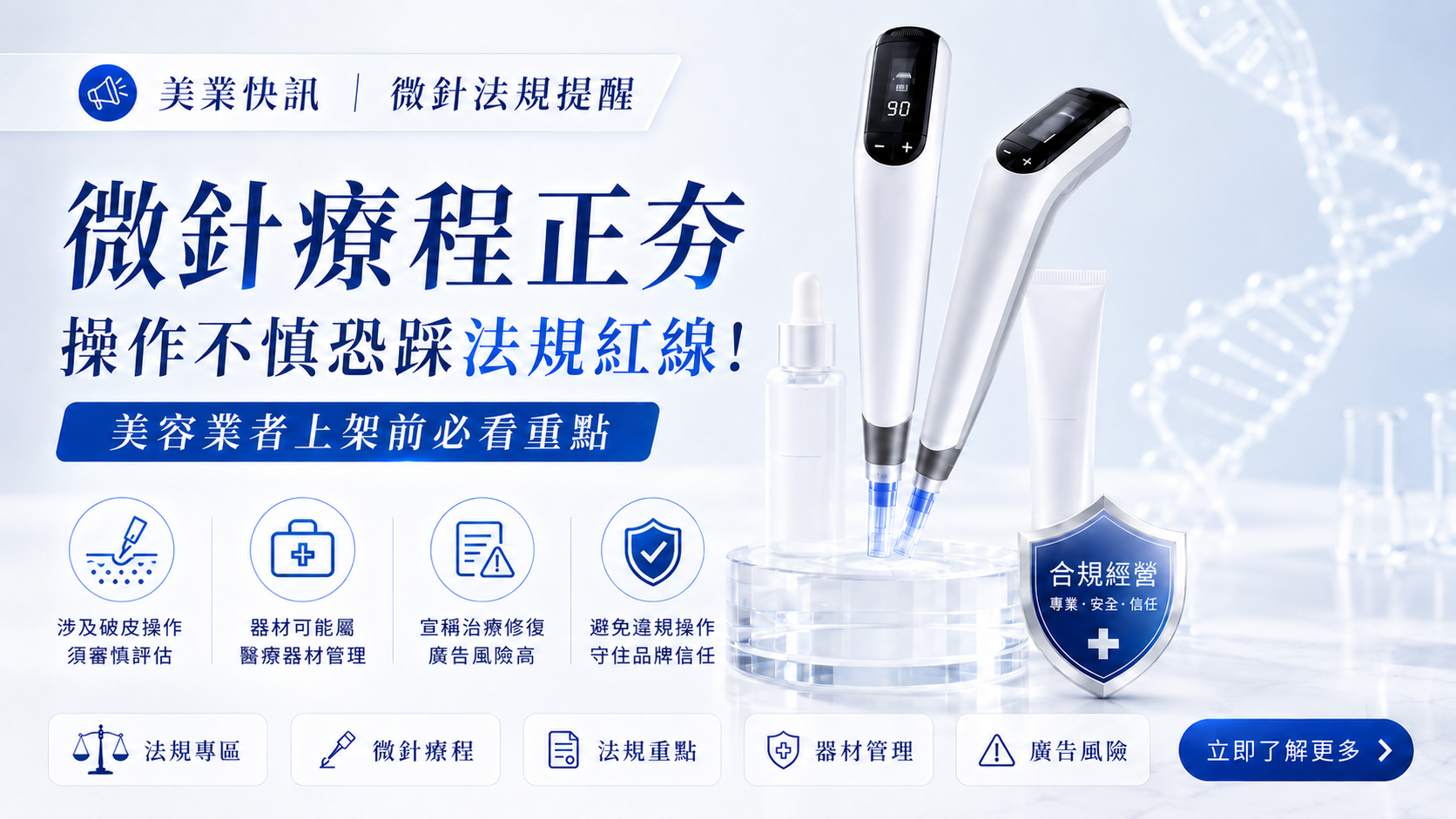
In recent years, topics such as microneedling, dermarolling, microneedling pens, and aquaglow treatments have rapidly increased in discussion within the beauty market, with many shops focusing their promotions on 'pores, acne scars, fine lines, collagen production, and skin repair.'
However, beauty industry businesses need to pay special attention:
As long as invasive or minimally invasive procedures are involved, or medical devices are used to improve appearance, it may fall under the category of aesthetic medicine.
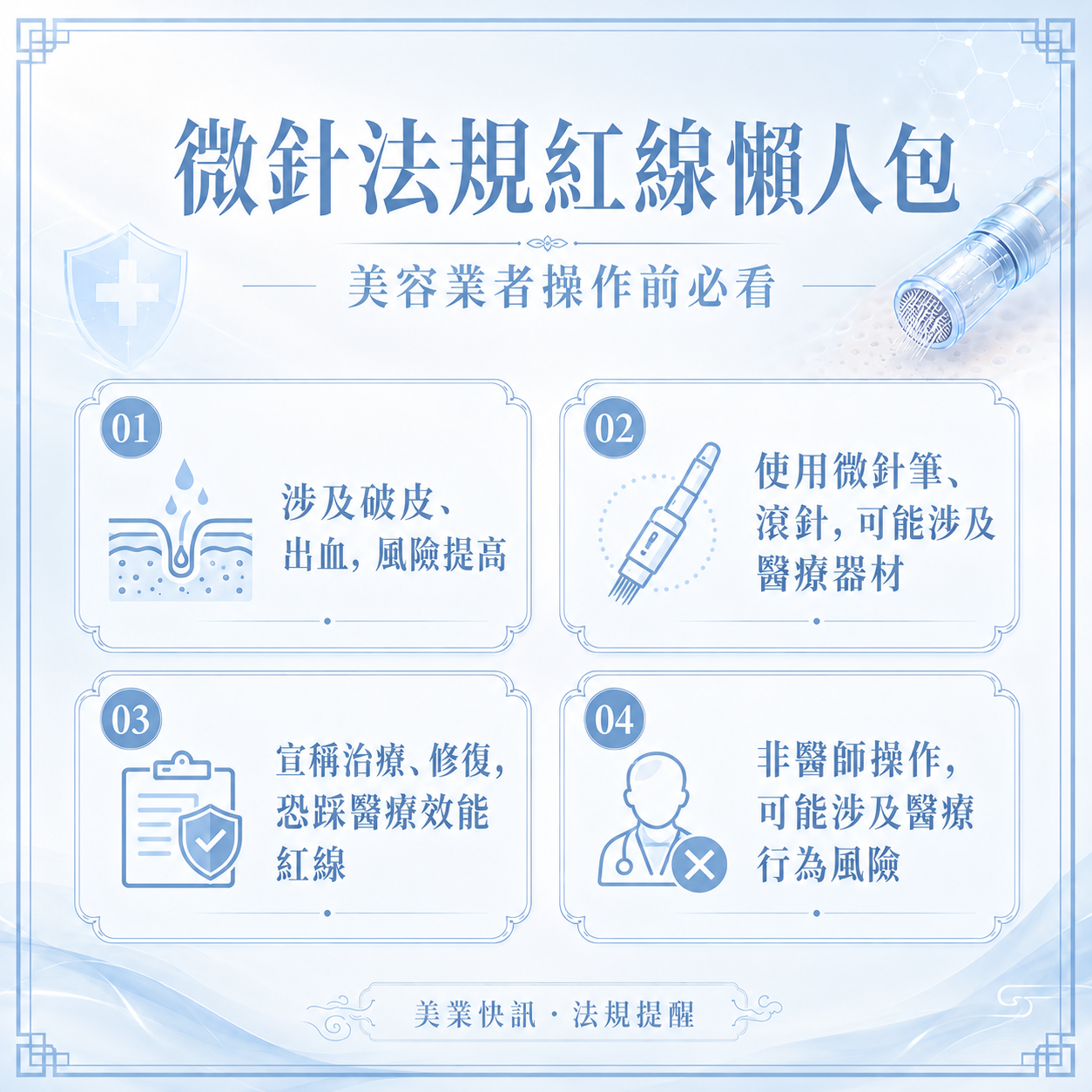
| Key Projects | Content Description |
|---|---|
| Risks of Microneedling Services | If it involves skin breaking, bleeding, wound formation, or ingredient infusion, it may not fall under general beauty care. |
| Operator Restrictions | If deemed a medical act, it should be performed by qualified medical personnel in accordance with the law. |
| Equipment Management Risks | Microneedling pens, dermarollers, and electric microneedles may involve medical device management. |
| Advertising Claim Risks | Terms like treating acne scars, repairing depressions, and stimulating collagen production may involve claims of medical efficacy. |
| Store Listing Recommendations | Before listing, confirm the service content, legality of equipment, operational qualifications, and compliance of advertising copy. |
Article Directory
- Why is microneedling prone to regulatory risks?
- Can beauticians perform microneedling?
- Microneedling equipment may also involve medical device management.
- What high-risk terms should beauty shop advertisements avoid?
- Five essential checks for beauty businesses before listing services.
- Safety reminders for consumers.
- Frequently Asked Questions (FAQ)
- Reminder from the Beauty Industry Union.
Key regulatory reminders.
Microneedling is not merely a matter of 'naming a treatment,' but whether the service content involves invasive, minimally invasive techniques, use of medical devices, and claims of medical efficacy.
When planning microneedling-related services, beauty businesses should avoid relying solely on 'needle length,' 'course certificates,' or 'foreign licenses' as judgment criteria, and instead return to examining actual operational methods and advertising content.
The Ministry of Health and Welfare has clearly stated that 'aesthetic medicine' is a medical act performed by physicians using surgical, pharmaceutical, medical device, or biotechnology techniques to improve physical appearance through invasive or minimally invasive techniques, and should be carried out by professionally trained medical personnel in accordance with relevant medical regulations.
1. Why is microneedling prone to regulatory risks?
The core of microneedling services is to create tiny channels or stimulate reactions on the skin surface using needles. If the procedure involves skin breaking, bleeding, wound formation, infusion of specific ingredients, or claims to improve acne scars, depressions, hair loss, scars, or treat skin issues, it is no longer just a general skin care service.
High-Risk Operational Scenarios
| Operational Scenarios | Possible Risks |
| Skin breaking, bleeding, wound formation | May involve invasive or minimally invasive procedures |
| Use of microneedling pens, dermarollers, or needles | Equipment may involve medical device management |
| Infusion of serums, ampoules, or special ingredients | May involve issues of product legality and efficacy claims |
| Claim to improve acne scars, pits, scars | May involve claims of medical efficacy |
| Promoting medical-grade or clinic-grade effects | May mislead consumers into thinking it is a medical service |
Advertising Copy Warning Box
If the shop's advertising copy includes:
'Treating acne scars,' 'repairing depressions,' 'stimulating collagen production,' 'improving skin diseases,' 'medical-grade treatments'
Such terms may involve claims of medical efficacy or medical acts.
Whether cosmetic advertisements involve false exaggeration or medical efficacy will be judged comprehensively by the authorities based on product names, text, images, sounds, and overall presentation. If it involves preventing, alleviating, diagnosing, or treating diseases, or involves the efficacy of drugs or medical devices, it may be recognized as a claim of medical efficacy.
2. Can beauticians perform microneedling?
The most common question among beauty businesses is:
'Is it true that as long as the needle is a bit shorter and the beautician has taken a course, they can perform it?'
In practice, one must still be very cautious.
If the service content involves invasive or minimally invasive techniques, or uses medical devices to improve appearance, the Ministry of Health and Welfare has classified it under medical acts.
Non-physicians performing medical business may face criminal liability under Article 28 of the Medical Practitioners Act. The law stipulates that those who perform medical business without legal physician qualifications, except for specific exceptions, may face imprisonment of six months to five years and may also be fined between NT$300,000 and NT$1.5 million.
Common Misunderstandings Among Shops
| Common Statements | Risk Reminders |
| I have taken a microneedling course | Course certificates do not equate to qualifications for performing medical acts |
| The needle is short, so it is not medical | It still depends on whether it involves skin breaking, bleeding, causing wounds, or claims of medical efficacy |
| Many beauticians abroad can perform it | In Taiwan, one must still judge according to domestic regulations |
| It is just skin management, not aesthetic medicine | If it involves invasive procedures or medical devices, it may still be deemed risky |
| As long as the client signs a consent form, it's fine | Consumer consent does not mean the service itself is legal |
Key Points for Judging Before Listing
If beauty businesses want to plan microneedling-related services, it is recommended not to rely solely on 'course certificates,' 'foreign licenses,' or 'equipment manufacturer training' as legal bases.
They should first confirm:
Whether the service itself involves medical acts, whether the equipment is classified as medical devices, and whether the advertising claims cross the line.
3. Microneedling equipment may also involve medical device management
Commonly seen microneedling rollers, microneedling pens, electric microneedles, and aquaglow devices may be classified under medical device management if their purpose, design, claims, or operational methods involve medical use.
The Medical Device Division of the Food and Drug Administration has clearly listed relevant management items such as the Medical Device Management Act, medical device inspection and registration, first-class medical device registration, medical device advertising, and online sales.
If a business intends to sell or supply but manufactures or imports medical devices without approval, according to Article 62 of the Medical Device Management Act, they may face imprisonment of up to three years, detention, or a fine of up to NT$10 million.
Those who knowingly sell, supply, transport, store, mediate, transfer, or display such medical devices may also be punished.
Equipment Inspection Key Points Table
| Inspection Items | Items the shop should confirm |
| Equipment Name | Is it a microneedling pen, dermaroller, electric microneedle, or aquaglow device? |
| Product Use | Does it claim to treat, repair, or improve skin issues? |
| Legal Source | Is there legal import, sales, or supply documentation? |
| Permit Documentation | Does it involve medical device permits, registration, or related management? |
| Usage Method | Does it cause skin breaking, bleeding, wound formation, or ingredient infusion? |
| Advertising Content | Does it imply medical effects or aesthetic treatment effects? |
4. Store advertising copy should avoid these high-risk terms

If microneedling-related services are to be promoted, the wording in the copy must be particularly cautious.
Below is a summary of common high-risk terms and safer alternative expressions.
High-Risk Claims vs. Safer Expressions
| It is recommended to avoid using | Safer expression directions |
| Treating acne scars | Skin care consultation |
| Smoothing depressions | Provide skincare advice based on skin condition |
| Scar repair | Daily skincare advice |
| Stimulate collagen production | Maintain skin hydration and glow |
| Improve hair loss | Scalp cleaning and care consultation |
| Treat follicle issues | Daily scalp care advice |
| Medical-grade microneedling | Professional skincare procedures |
| Comparable to medical beauty clinics | Comfortable skincare experience |
| Introduce effective ingredients through broken skin | Combine with legal cosmetics for skincare |
| Improve skin diseases in one session | Provide skincare advice based on personal skin condition |
| Safe and risk-free, guaranteed effective | Actual results may vary based on individual conditions |
Copy reminder box
Beauty industry advertisements can emphasize aspects like 'skincare', 'consultation', 'daily care', 'cleaning', 'hydration', etc.
However, avoid using terms that may lead consumers to believe they have therapeutic, restorative, diagnostic, preventive effects, or alter body structure.
5. Before listing microneedling-related services, it is recommended to check 5 items
Before planning microneedling, rolling needles, microneedling pens, or water light introduction services, it is recommended that the store complete the following self-check.
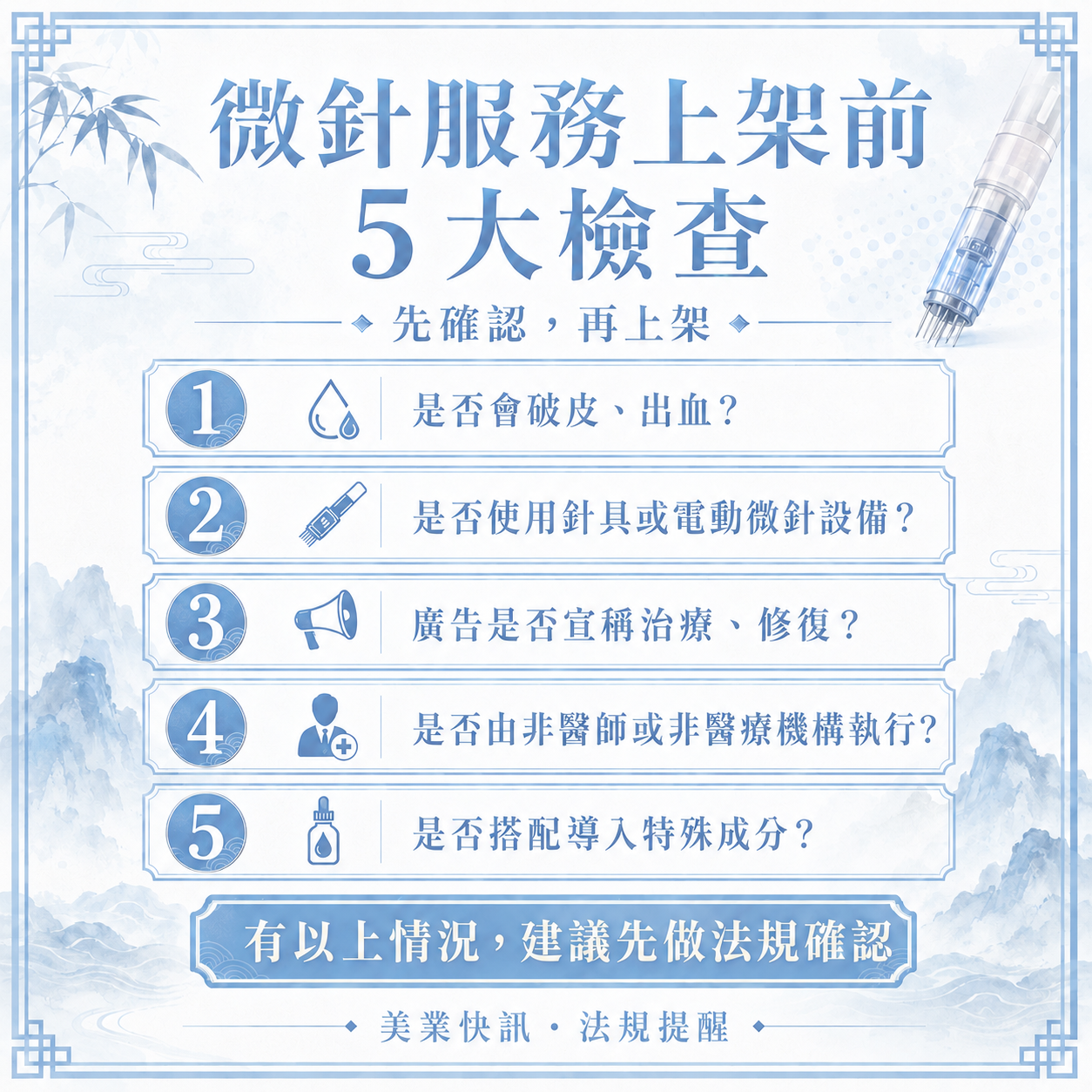
Top 5 checklists before listing microneedling services
| Check items | Check content | Risk reminders |
| 1. Will it cause broken skin, bleeding, or wounds? | Check if the operation process causes skin damage | If so, the risk is extremely high and may involve medical behavior |
| 2. Are needles or electric microneedling devices used? | Check if microneedling pens, rolling needles, or water light devices are used | Confirm whether the equipment is classified as medical equipment |
| 3. Does the advertisement claim treatment or repair? | Check if the copy mentions acne scars, pits, scars, hair loss, etc. | May involve claims of medical efficacy |
| 4. Is it performed by non-physicians or non-medical institutions? | Check the qualifications of the operators and the nature of the location | If deemed medical behavior, it may violate the 'Physician Act' |
| 5. Is it combined with the introduction of special ingredients? | Check if the products used are legal cosmetics, drugs, or medical materials | If it involves drugs or medical materials, regulations need to be re-evaluated |
Quick judgment box
If your service has the following situations, it is recommended to postpone listing and first confirm regulations:
- Will cause broken skin or bleeding
- Will form tiny wounds
- Use needles or electric microneedling devices
- Use anesthetics or post-operative repair products
- Claims to improve acne scars, depressions, or scars
- Claim to stimulate collagen production
- Use terms like 'medical beauty grade', 'treatment', 'repair', etc.
- Combine with high-concentration essences, ampoules, or products of unknown origin
6. Reminders for consumers

Consumers should not only look at price, influencer recommendations, or social media photos when choosing microneedling, rolling needles, or related treatments.
If the treatment involves needles, broken skin, bleeding, anesthetics, repairing acne scars, improving pits, or treating skin issues, it is recommended to choose a legal medical institution and proceed after evaluation by a qualified physician.
The Ministry of Health and Welfare has also reminded that cosmetic medicine itself carries uncertain risks and should be performed by professionally trained medical personnel according to relevant medical regulations to ensure public safety.
Consumers can confirm before choosing
| Confirmation items | Suggested inquiry content |
| Operation location | Is it a legal medical institution? |
| Operator | Is it performed by a qualified physician or qualified medical personnel? |
| Equipment used | Is it from a legal source, does it have relevant permits? |
| Treatment content | Will it cause broken skin, bleeding, use anesthetics, or cause wounds? |
| Claimed effects | Is there excessive guarantee of effects or claims of treating diseases? |
| Risk explanation | Is there a complete disclosure of possible side effects and precautions? |
7. Frequently Asked Questions FAQ
Q1: Is microneedling done very shallow still considered medical behavior?
It cannot be determined solely by 'depth'. It still depends on whether the actual operation causes broken skin, bleeding, wounds, whether medical instruments are used, and whether it claims to treat or improve diseases, scars, pits, etc.
Q2: Can beauticians who have taken microneedling courses operate on clients?
Course certificates do not equate to medical qualifications. If the service content is deemed to involve medical behavior, it should still be performed by qualified medical personnel according to regulations.
Q3: Can stores sell microneedling pens or rolling needles?
If the purpose, design, or claims of the equipment involve medical use, it may fall under the management scope of medical equipment. Before selling or supplying, it should first be confirmed whether medical equipment-related permits or registrations are needed.
Q4: Can advertisements say 'improve acne scars'?
Such wording easily involves claims of medical efficacy and carries higher risks. It is recommended to avoid using terms like treatment, repair, improve diseases, or alter body structure.
Q5: Can microneedling be combined with essence introduction?
If it involves broken skin introduction, special ingredients, drugs, medical equipment, or efficacy claims, the risks will increase. It is recommended to first confirm the legality of the products and the positioning of the services.
8. The Beauty Industry Alliance reminds
Microneedling-related services have received high attention in recent years, but for beauty practitioners, what truly needs to be emphasized is not just market demand, but also the legality of operations, compliance of equipment, and risks of advertising claims.
Before listing services, it is recommended that practitioners ensure to check:
| Check direction | Key reminders |
| Service content | Does it involve invasive or minimally invasive operations? |
| Operator | Do they have legal execution qualifications? |
| Equipment used | Does it involve medical equipment management? |
| Products used | Are they legal products, do they involve drugs or medical materials? |
| Advertising copy | Does it avoid medical efficacy or exaggerated claims? |
| Consumer notification | Is there a clear reminder of risks and legal options? |
Conclusion
Beauty industry services can be professional, but they must also be legal, safe, and reassuring.
Items such as microneedling, rolling needles, microneedling pens, and aquaglow infusion involve needles, skin irritation, infusion, and claims of effectiveness, which can easily cross the regulatory red lines of medical practices, medical devices, and advertising claims.
Confirm the regulatory red lines before launching to maintain brand trust and consumer safety.